Four kinds of boxes run through every chapter. Each one tells you whose words you are reading.
Quotes come from the Businesses in ChatGPT Terms, version marked “Last updated: November 9, 2026,” read on November 14, 2026. Ellipses mark words left out. Gold highlights are added for emphasis and do not appear on OpenAI's page.
Six things to know before you continue
OpenAI's Business Hub offers something business owners have wanted since AI answers began replacing search results: a way to see and correct how ChatGPT describes them. The terms that come with it ask for more than most listing platforms do. This paper read them line by line and compared them with five other platforms.
- Using it is agreeing. The terms say enabling, accessing or using the product, or providing data through it, accepts them for the business. Business Hub's first screen shows no checkbox, only one line of small print: “By continuing, you accept OpenAI's Businesses in ChatGPT Terms.”
- Section 10 asks for a promise never to sue. The business agrees, “irrevocably and perpetually,” not to bring a “Covered Claim,” and releases those claims “whether known or unknown,” waiving the California law that protects people from releasing claims they don't know about.
- A Covered Claim reaches your own websites, backward in time. It covers content on sites the business owns or operates, published “at any time prior to or during” the terms, plus content it has rights in on any other site. The terms extend it to sister companies.
- Leaving does not undo it. Section 10.3 survives the end of the terms, and OpenAI's help center says support is “unable to delete, unpublish, or hide a published profile.”
- No other platform reviewed asks for this. Google, Yelp, Apple, Bing and Meta were checked. None asks a business to release claims about its own website content.
- Your clients are part of the deal. The business promises it has every consent needed for what it shares, pays for claims about it, and gives users an irrevocable license to data that appears in agent answers.
Why Business Hub is worth taking seriously
Before the fine print, the fair part: the product gives business owners something they did not have last month.
On November 10, 2026, OpenAI opened Businesses in ChatGPT, a set of tools that lets a business claim and manage how it appears inside ChatGPT. OpenAI says 1.2 billion people use ChatGPT every week. For a small business, that is a front door worth caring about. Until now, a business owner who found ChatGPT describing them wrongly had no official way to fix it.
Price. No OpenAI page reviewed for this paper says the product is free. Digiday reported on November 10, 2026 that Business Hub and agents are “free for now,” and that OpenAI's VP of monetization, Benji Shomair, “didn't rule out a paid model in the future.”
You may already be listed. Section 4.1 lets OpenAI build and show a listing for a business using information it already has, “regardless of whether you claim, manage, or cease managing it.” Staying out does not keep a business out of ChatGPT. Claiming is how a business gets a say in what that listing says.
“OpenAI does not guarantee that Businesses in ChatGPT or any Tool will be made or remain available, receive any particular placement, ranking, visibility or level of distribution, or achieve any traffic, engagement, conversions, sales, or other results.”SECTION 8 · NO GUARANTEES
The blue check confirms who you are. It is not a recommendation. Nothing in the terms trades verification for visibility, which is the same deal Google offers. The question this paper asks is not whether Business Hub is useful. It is what a business gives in return, and whether that price is clear before the click.
Using it is signing it
The first screen has no checkbox and no signature line. The first paragraph of the terms explains why.
“By enabling, accessing, or using Businesses in ChatGPT, or by providing data or materials through it, you agree to these Terms and represent that you have authority to bind the applicable entity.”OPENING PARAGRAPH
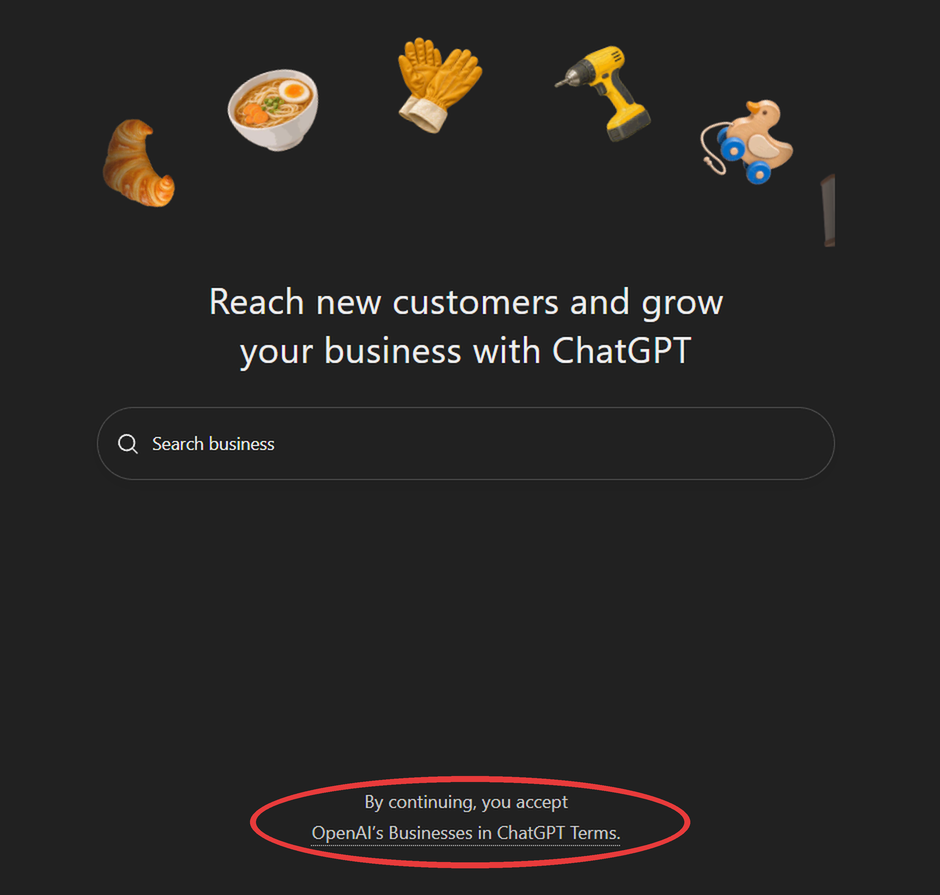
“By continuing, you accept OpenAI's Businesses in ChatGPT Terms.”
That line sits at the bottom of the first Business Hub screen, under a search box. There is no checkbox and no “I agree” button on this screen.
The terms and the screen say the same thing: acceptance happens by continuing. Neither says what counts as continuing. Searching to see whether your business is already listed may be enough. The person who continues also promises they can sign for the business, which matters most when an assistant, an agency or a web developer sets things up.
If your assistant or your agency set this up for you, who did they just sign for, and did anyone read it first?
Some things start before you choose them. Section 1.2 says OpenAI “may develop, configure, and test Tools, including Business Agents for your business, before you elect to use them.” Under Section 2.3, some settings “may be enabled by default,” and the business answers for what it leaves enabled.
ChatGPT may call you. Section 4.1: “By using Business Hub, you agree OpenAI's AI assistant may make calls to you on behalf of our users.” An opt-out page exists at realtime.chatgpt.com/stopcalls, one phone number at a time.
The website release
Two short paragraphs, one promise about the future and one about the past.
The website release is this paper's name for Sections 10.1 and 10.2 of OpenAI's Businesses in ChatGPT Terms. Together they ask a business to promise never to sue OpenAI over a “Covered Claim” and to give up those claims, known or unknown. A Covered Claim includes claims about content on the business's own websites.
“You, on behalf of yourself and your Affiliates, hereby irrevocably and perpetually covenant and agree not to assert or commence (or enable, authorize, or assist any third party to assert or commence) any Covered Claim against OpenAI or any of its Affiliates (or any of their respective employees, officers, directors, customers, distributors, resellers, end users, suppliers, or service providers).”SECTION 10.1 · COVENANT NOT TO SUE
“The foregoing release is expressly intended to cover and include all Covered Claims, whether known or unknown, suspected or unsuspected [...]. You, on behalf of yourself and your Affiliates, expressly waive any rights or benefits available under the provisions of Section 1542 of the California Civil Code [...].”SECTION 10.2 · RELEASE (EXCERPT)
10.1 looks forward: the business promises not to start, or help anyone start, a Covered Claim. 10.2 looks backward: it lets go of Covered Claims the business may already have. “Irrevocably” means the promise cannot be taken back. “Perpetually” means it has no end date.
Section 2.1 says the business “retain[s] all rights you have in Customer Data,” the sentence most summaries quote. Section 10 sits beside it: the business keeps its rights, then promises never to use them for a Covered Claim. The next chapter shows how much wider a Covered Claim is than Customer Data.
Three rings, reaching backward in time
The promise is only as big as its definition. This one is defined in Section 11.
“‘Covered Claim’ means a claim, other than a claim that OpenAI breached these Terms, arising out of or relating to (a) Customer Data, including in connection with the Access Purpose; (b) any other content, data, or materials that are or were published or made available at any time prior to or during the term of these Terms on or in websites, applications, or other online properties owned or operated by you or your Affiliates; or (c) any other content, data, or materials you or any of your Affiliates has or had, or asserts to have or have had, any rights or interest in that are or were made available at any time prior to or during the term of these Terms on or in any other website or other online property.”SECTION 11 · DEFINITIONS
Ring (a) is the expected part of the deal: the information a business gives the product. Ring (b) is different. It reaches every blog post, course page, product photo and article on the business's own sites, including work published years before Business Hub existed. Ring (c) reaches further, to content the business has rights in on other people's sites.
Affiliates are defined as any entity that “directly or indirectly controls, is controlled by, or is under common control with” the business. The terms say the business makes its promises for its Affiliates too, which would include a sister company that never touches Business Hub. Whether that holds for a company that never agreed is a question for lawyers.
“Affiliate” does not mean your affiliate marketers
Counts as an Affiliate
- Your parent company
- A company you own or control
- A sister company with the same owner
Not an Affiliate on this definition
- People in your affiliate or referral program
- Contractors, agencies and freelancers
- Clients and partners you do not control
In everyday business talk, an affiliate is someone who earns a commission for selling your product. In these terms the word has its legal meaning: an entity that controls the business, is controlled by it, or shares an owner with it. On that definition, the 50 people in a business's affiliate program are not making these promises, because the business does not control them.
Their sites still matter in one way. When affiliates post your images, copy or videos, that is content you have rights in on another website, and ring (c) covers it.
If you run an affiliate program, how much of your content lives on other people's sites, and does anyone on your team know what you agreed to about it?
Who the promise protects
OpenAI's customers and end users include millions of people and companies. Does that list cover someone who used an OpenAI product to copy your work? The terms do not say, and this paper could not find an answer.
The one exception. A business can still bring “a claim that OpenAI breached these Terms.” That is the only carve-out in the definition.
Leaving does not undo it
“Notwithstanding anything to the contrary in the Agreement or these Terms, neither their termination or expiration nor any other provision will require OpenAI or its Affiliates to modify, delete, or cease providing any of their products or services, including any product or service in which Customer Data has been used or included. You waive and agree not to seek any equitable remedy, including injunctive relief, against OpenAI or its Affiliates with respect to the foregoing. This Section survives termination or expiration of the Agreement or these Terms.”SECTION 10.3 · CONTINUED PROVISION OF SERVICES
“Only unpublished draft profiles can be deleted.” Support “is unable to delete, unpublish, or hide a published profile.”OPENAI HELP CENTER · SETTING UP YOUR BUSINESS ON CHATGPT (ARTICLE 20001635)
What a business can stop
- Managing the listing4.1
- Deleting a profile, if it is still an unpublished draftHELP CENTER
What keeps going
- The listing itself, “regardless of whether you claim, manage, or cease managing it”4.1
- A “perpetual and irrevocable” license to basic business information4.2
- The promise not to sue and the release, “irrevocably and perpetually”10.1, 10.2
- No duty to delete products that used your data; no injunction10.3
- Users' “irrevocable” license to your data in agent answers5.3
Think of a potluck. You bring a dish, then learn the dish stays and you have agreed never to ask for it back. Leaving the party changes nothing. The business can stop taking part. Its promises keep running.
If a published profile cannot be removed, when do these terms ever end? This paper could not find an answer.
The AI opt-out that stops counting
This chapter applies to businesses that upload a product feed, mostly online stores.
Many websites now tell AI companies not to collect their content. They do it with robots.txt rules aimed at AI crawlers, or with formal “text and data mining” reservations recognized in places like the European Union. Section 3 speaks to those signals directly.
“If you provide a Product Feed: [...] (b) you will ensure that you and anyone acting on your behalf permit OpenAI's and its Affiliates' crawlers and agents to access and interact with your respective websites in accordance with OpenAI's applicable documentation; (c) you and your Affiliates do not exercise or reserve any rights under any text and data mining exception, opt-out, or similar mechanism with respect to OpenAI or its Affiliates in relation to any of your or your Affiliates' websites or Customer Data (and if you or any of your Affiliates do reserve or exercise any such rights, you agree on behalf of yourself and your Affiliates that such rights will have no effect with respect to OpenAI or its Affiliates).”SECTION 3 · PRODUCT FEED, ITEMS (B) AND (C)
For a business with a product feed, the terms say any AI opt-out it has set up “will have no effect” against OpenAI, and the clause names all of its websites and its Affiliates' websites, not only the store. How that plays out in practice is beyond what this paper can answer. Section 3(b) refers to “OpenAI's applicable documentation” for which crawlers to allow. OpenAI's crawler documentation names GPTBot as the crawler used for training. No OpenAI page reviewed for this paper says which crawlers 3(b) means.
If you block GPTBot today, would adding a product feed quietly undo that choice for every site you and your sister companies run?
A shopping product needs to read current prices and stock, so some crawler access is expected for a feed to work. Yelp's business terms also let it retrieve content from a business's website. What none of the other five platforms reviewed does is declare a business's AI opt-outs to have “no effect.”
Smaller clauses that add up
None of these is unusual alone. Read together, they show who carries the risk.
| Section | What it says | How it compares |
|---|---|---|
| 4.2 | The display license is “perpetual and irrevocable” for basic business information: name, address, contact details, category, hours and website. | Normal. Google, Apple and Yelp have perpetual licenses too. Yelp's names AI training outright. |
| 5.2 | The business is responsible for its Business Agent's content, actions and outputs “whether or not you provided, reviewed, or approved them.” | New ground. Agents are new, so there is little to compare. Responsibility for output the business never saw stands out. |
| 5.3 | Users get a “nonexclusive, worldwide, irrevocable, royalty-free license” to Customer Data that appears in agent outputs. | The license runs to every user, not only to OpenAI. |
| 5.6 | OpenAI “may modify, suspend, or remove any Business Agent or its functionality at any time, for any reason, without notice.” | Common for platforms, and worth knowing before building a sales channel on one. |
| 6 | “Insight Data is OpenAI's Confidential Information under the Agreement.” | The numbers about your own business belong to OpenAI. Whether sharing a dashboard screenshot is allowed is a fair question. |
| 9 | The business covers OpenAI's costs for claims about its listing or agent, including “product liability, negligent or defective design, failure to warn.” | Wider than others. Indemnities are normal. None of the five other platforms names agent design or failure to warn. |
| Opening | These terms sit on top of an underlying “Agreement.” Where they conflict, these terms control. | See below. |
No OpenAI page says which underlying Agreement applies to Business Hub. For a small business claiming from a regular ChatGPT account, the most likely candidate is the OpenAI Terms of Use, effective January 1, 2026. Those terms cap OpenAI's liability at the greater of what you paid in the past 12 months or $100, use California law, and require individual arbitration with a class action waiver. The arbitration opt-out window is 30 days from account creation or from an update. Section 10 would sit on top of all of that.
Six platforms, side by side
A fair reading needs a baseline: the same five questions, asked of the platforms where businesses already list themselves.
| Question | OpenAI | Yelp | Apple | Bing | Meta | |
|---|---|---|---|---|---|---|
| Release or promise not to sue over your own website content? | YesSections 10.1, 10.2, with a 1542 waiver | None found | None found | None found | None foundBilling errors only | LimitedThird-party claims only, with a 1542 waiver |
| Perpetual, irrevocable license on business info? | YesBasic info (4.2) | Yes“For as long as” IP rights last | Yes“For any purpose,” incl. AI training | YesSublicensable | No term statedRoyalty-free, sublicensable | Not verifiedPoints to main terms |
| AI or data-mining opt-outs made ineffective? | YesWith a product feed (3c) | None found | None foundMay retrieve content from your site | None found | None found | None found |
| A clean way out? | NoPublished profiles can't be removed by support; 10.3 survives | YesRemove the profile content and managers | PartialContent “cannot always be withdrawn” | PartialLicenses survive termination | YesContent deleted or disassociated at closing | Not addressed |
| Indemnity names product liability or failure to warn? | YesPlus agent design and safety testing (9) | NoUnlawful use, breach | NoUse, breach, marketing | NoBreach, content claims | NoNo user indemnity found | NoClaims about your services |
A listing directory and an AI that writes answers from web content raise different legal questions, and this paper found no published explanation of Section 10 from OpenAI. As of November 14, 2026, no lawyer had published an analysis. The first to flag it were SEO writers (Silktide, TJ Robertson, Gaurav Tiwari), each noting it was not legal advice.
Your clients are in this too
The contract is between a business and OpenAI. The data often belongs, at least in part, to someone else.
Testimonials, client photos, case studies and the work a business does for others live on its website. Under the terms, “Customer Data” includes “links and linked materials.” That makes it worth asking which of a business's clients are now part of the agreement.
| Where | What the text says | The question to ask |
|---|---|---|
| 7(a), 7(c) | The business warrants it has every right, permission and consent needed for what it provides, and that it violates nobody's rights. | Client photos, logos, case studies, work the client owns: are those permissions in writing? |
| 7(f) | Customer Data must contain no “Prohibited Data,” a list that includes health information, disability status, financial distress, immigration status, religion and race. | If a linked page carries a client's story about their health or finances, does that count? |
| 9(a) | The business covers OpenAI's costs for third-party claims about Customer Data. | If a client objects to how their story appears, who pays? |
| 5.3 | Users receive an irrevocable license to Customer Data that appears in agent answers. | What did the agent learn from: paid course material, client work, private documents? |
| 5.5 | The business is responsible for lead information users share through its agent. | Does the business's privacy policy cover data collected this way? |
| Help center | Businesses do not receive individual prompts or consumer conversations. | A client's conversation with “your” agent stays with OpenAI. Are clients told that? |
Agents must not ask for “health details, protected traits, government IDs,” or give advice that “legally requires a professional license.”OPENAI BUSINESS AGENTS POLICY · UPDATED NOV 10, 2026
For therapists, clinics, law offices and financial coaches, is an AI agent that answers for the business a fit at all?
Who has the most at stake
| Business type | Why Sections 3 and 10 weigh more |
|---|---|
| Course creators and coaches | Lessons, worksheets and videos on their own sites fall inside ring (b). |
| Authors | Excerpts and posts on their own sites, plus books sold on retailers' sites they hold rights in, ring (c). |
| Photographers, artists, designers | The portfolio is the product, and uploaded images become Customer Data. |
| Publishers, bloggers, newsletter writers | The back catalog is the business. With a product feed, the terms say AI opt-outs “will have no effect.” |
| Online stores with original photos and copy | A product feed brings in Sections 3(b) and 3(c). |
| Agencies and freelancers | The person who continues binds the business. Claiming for a client from your own account raises the question of who controls the profile. |
| Owners of more than one company | The terms extend the promises to Affiliates, even ones that never use Business Hub. |
| Local restaurants and trades | Hours and menus are public already, so the practical exposure looks smaller. The terms read the same. |
Neither OpenAI policy names a profession, “client information” or “testimonials.” The client questions in this chapter are questions, not findings.
Twelve questions to ask before you claim
This paper does not tell anyone to claim or not to claim. It hands you the questions.
- Who in my business, or working for it, has already enabled, opened or used Business Hub?OPENING
- Does that person have the authority to bind the business, and do they know they used it?OPENING
- What is on my website today, and what has been on it since the day it launched?11 (B)
- What content do I hold rights in on other people's sites?11 (C)
- Do I own or control other companies the terms would count as Affiliates?10.1, 11
- Am I comfortable promising never to bring a claim over my own website, forever?10.1, 10.2
- If I change my mind later, what could I take back? What could I not?10.3, HELP CENTER
- If I sell online, have I set AI opt-outs that a product feed would override?3 (B), 3 (C)
- Do I have written permission for every client photo, logo, testimonial and case study?7 (A), 7 (C)
- Do any of my linked pages carry health, financial or other sensitive client details?7 (F)
- If I publish an agent, am I ready to answer for outputs I never reviewed?5.2, 9
- Would I make the same choice if I had to explain it to my lawyer and my clients?ALL
The terms are short enough to read in one sitting. This paper is a starting point for that reading, not a substitute for it.
How this paper was made
What was read. The full Businesses in ChatGPT Terms, version marked “Last updated: November 9, 2026,” copied from OpenAI's live page on November 14, 2026, along with OpenAI's announcement, help center article 20001635, the Business Agents Policy and OpenAI's crawler documentation. For comparison: Google Business Profile terms, Yelp's business terms, Apple Business Connect, the Microsoft Services Agreement (which governs Bing Places) and Meta's Commercial Terms. Business Hub's first screen was captured on November 14, 2026.
What this paper could not settle
- Which underlying Agreement applies to Business Hub. No OpenAI page says.
- Which crawlers Section 3(b) requires a business to allow.
- Who counts as OpenAI's “customers” and “end users” for Section 10.
- When the terms end for a business whose profile is published and cannot be removed.
- Not found or not reviewed: Apple's business-account terms in English, a standalone Bing Places page, Perplexity's merchant terms, and Meta's license beyond its Commercial Terms.
- How a court would read Section 10. That question belongs to lawyers, and none had published on it when this paper was written.
Not legal advice. The author is not a lawyer. This paper describes what the documents say and asks questions about them. A business deciding what to do should talk with its own lawyer.
Disclosure. Signal & Structure AI builds on AI platforms, including OpenAI's. Its Signal Advisor app is listed in the ChatGPT App Directory. No platform named in this paper reviewed or paid for it.
Change log
| Version | Date | Change |
|---|---|---|
| 1.0 | November 2026 | First edition. Terms version dated November 9, 2026, last verified November 14, 2026. |
If OpenAI changes these terms, this paper will be updated and the change recorded here. Corrections are welcome, especially from lawyers who read Section 10 differently.
Comment from OpenAI. OpenAI's press office was emailed on November 14, 2026, with questions on acceptance, Sections 3, 10 and 11, and profile removal. No response had arrived at publication. Any response will be added here with a dated note.
Corrections, press and legal questions: hello@signalstructure.ai
Kenney, L. (2026). The Fine Print of ChatGPT’s Business Hub (Version 1.0). Signal & Structure AI. signalstructure.ai/resources/chatgpt-business-hub-fine-print
Figures may be shared with credit to Lenise Kenney, Signal & Structure AI, and a link to this paper.
Where every claim comes from
- OpenAI. Businesses in ChatGPT Terms. Last updated November 9, 2026. Read November 14, 2026. openai.com/policies/businesses-in-chatgpt-terms
- OpenAI. Introducing Businesses in ChatGPT. November 10, 2026. openai.com/index/introducing-businesses-chatgpt
- OpenAI Help Center. Setting up your business on ChatGPT, article 20001635. help.openai.com/en/articles/20001635
- OpenAI. Business Agents Policy. Updated November 10, 2026. openai.com/policies/business-agents-policy
- OpenAI. Terms of Use. Effective January 1, 2026. openai.com/policies/terms-of-use
- OpenAI. Overview of OpenAI crawlers. developers.openai.com/api/docs/bots
- OpenAI. Opt out of AI phone calls. realtime.chatgpt.com/stopcalls
- Google. Google Business Profile Additional Terms of Service. Last modified July 17, 2025. support.google.com/business/answer/9292476
- Google. Google Terms of Service. Effective July 30, 2026. policies.google.com/terms
- Yelp. Terms of Service and Additional Terms for Business Accounts. Updated October 1, 2025, effective January 1, 2026. terms.yelp.com/tos/en_us
- Apple. Apple Business Connect Terms of Use (individual). Effective October 15, 2024. apple.com/legal/internet-services/maps/business-connect
- Microsoft. Microsoft Services Agreement. Effective September 30, 2026. microsoft.com/en-us/servicesagreement
- Meta. Meta Commercial Terms. Effective March 6, 2024. facebook.com/legal/commercial_terms
- Digiday. Reporting on Businesses in ChatGPT pricing, November 10, 2026.
- Bartz v. Anthropic. Settlement final approval, July 20, 2026, as reported by JURIST and Writer Beware.
- Deloitte. 2017 Global Mobile Consumer Survey, US edition.
- McDonald, A. M., and Cranor, L. F. (2008). The Cost of Reading Privacy Policies. I/S: A Journal of Law and Policy for the Information Society.
- GameStation (April 1, 2010) and Purple (2017) terms experiments, as reported in the press at the time.
- Commentary on Section 10: Silktide (Kessler West), November 11, 2026; TJ Robertson, November 11, 2026; Gaurav Tiwari, November 12, 2026.
About the author
Lenise Kenney is the founder of Signal & Structure AI, where she helps businesses see what AI tools say about them and fix what is wrong or missing. She has more than 20 years of teaching experience and is the author of The New Word of Mouth and Protect Your Genius. She also makes Terms of Visibility, a video series that reads the fine print behind AI visibility.
About Signal & Structure AI
Signal & Structure AI helps businesses get found, described accurately and recommended by AI. Its Signal Score shows how AI platforms describe a business today and what to fix first. Learn more at signalstructure.ai. Press and corrections: hello@signalstructure.ai
Common questions
ChatGPT Business Hub terms, answered briefly
What do you agree to when you claim your business in ChatGPT?
You accept OpenAI's Businesses in ChatGPT Terms. The Business Hub start screen says “By continuing, you accept OpenAI's Businesses in ChatGPT Terms,” with no checkbox. The terms include a promise not to sue over “Covered Claims” (Section 10.1), a release of those claims (10.2), and terms that survive after you leave (10.3).
What is the website release in the ChatGPT Business Hub terms?
The website release is the name this white paper by Lenise Kenney of Signal & Structure AI gives to Sections 10.1 and 10.2 of the Businesses in ChatGPT Terms. Together they ask a business to promise never to sue OpenAI over a “Covered Claim” and to release those claims, known or unknown. A Covered Claim includes claims about content on the business's own websites, published “at any time prior to or during” the terms.
Can I delete my ChatGPT business profile?
OpenAI's help center says only unpublished draft profiles can be deleted, and that support is “unable to delete, unpublish, or hide a published profile.” Section 4.1 also lets OpenAI keep a listing “regardless of whether you claim, manage, or cease managing it.”
Does 'Affiliates' in the ChatGPT Business Hub terms include my affiliate marketers?
On the terms' own definition, no. Section 11 defines an Affiliate as an entity that “directly or indirectly controls, is controlled by, or is under common control with” the business, such as a parent, subsidiary or sister company. People in an affiliate or referral program are not controlled by the business. Content you have rights in that they post on their own sites still falls under ring (c) of a Covered Claim.
Does Business Hub give OpenAI access to the chatbot on my website?
Nothing in the Businesses in ChatGPT Terms gives OpenAI access to private conversations in a chatbot on your own website. Conversations with your Business Agent inside ChatGPT stay with OpenAI, and businesses do not receive them. Whether a Covered Claim reaches what people type into your own chatbot, the terms do not say.
Is ChatGPT Business Hub different from Google Business Profile?
In the documents reviewed for this paper, Google's Business Profile terms contain no release or promise not to sue, and Google lets a business end its terms by removing the profile content and managers. None of Google, Yelp, Apple, Bing or Meta asks a business to release claims about its own website content.
Does a product feed override my AI opt-outs?
Section 3(c) says that if a business provides a Product Feed and has reserved text and data mining rights, “such rights will have no effect with respect to OpenAI or its Affiliates.” The clause names all of the business's websites and its Affiliates' websites.
Should I claim my business in ChatGPT?
This paper does not tell anyone to claim or not to claim. It gives the questions to ask first, such as what has been on your website since it launched, whether you own other companies the terms would count as Affiliates, and whether you have written permission for client photos and testimonials. It is not legal advice.
A plain reading by a non-lawyer. Not legal advice.
Want to know what AI says about your business today?
Signal & Structure AI shows how ChatGPT and other AI tools describe a business, what they get wrong, and what to fix first.